

What is RAG evaluation, and why does it matter?
RAG Evaluation for Beginners: How to Test Your Chatbot’s Answers starts with a simple question: did the chatbot find useful evidence and use it correctly? Retrieval-Augmented Generation (RAG) is a method that gives a chatbot relevant information from a knowledge base before it generates an answer. RAG evaluation checks that full process, not just whether the chatbot replies.
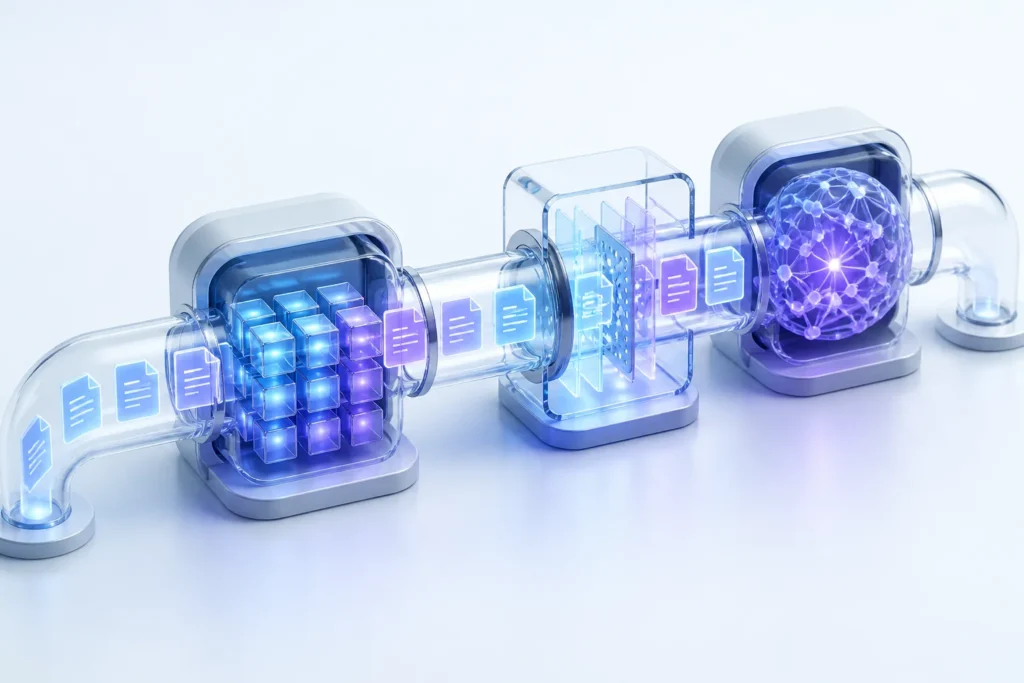
A RAG pipeline connects documents to a large language model (LLM). First, documents are indexed so a retrieval system can search them. When someone submits a user query, the system retrieves relevant passages; the model then uses that retrieved context to compose an answer.
A fluent response can still be wrong. The system might retrieve an outdated policy, miss a key passage, or generate a claim that the source never supports. Those unsupported or fabricated claims are hallucinations. A confident tone doesn’t prove that the answer is grounded in evidence.
For example, a customer asks whether a discounted item can be returned. If the chatbot retrieves the general return policy but misses the exception for sale items, it may give a polished yet misleading answer. Testing should reveal whether the problem began with indexing, retrieval, or generation.
Teams building customer support chatbots, question-answering systems, lead qualification tools, and custom AI applications benefit from checking answer quality before launch and as the system changes. RAG Evaluation for Beginners: How to Test Your Chatbot’s Answers is useful as a working description of that task: inspect the source documents, evidence selected, and final response together.
Checking that a bot responds is not evaluation. RAG Evaluation for Beginners: How to Test Your Chatbot’s Answers means assessing the path from documents to retrieved evidence to the answer a user sees. That distinction helps you fix the actual failure instead of simply changing the wording of a prompt. Use RAG Evaluation for Beginners: How to Test Your Chatbot’s Answers as a reminder to assess evidence and answer quality as one connected workflow.

Start your AI knowledge base project
What to take from this
- Evaluate indexing, retrieval, and generation separately as well as together.
- Use retrieval metrics such as precision, recall, and ranking quality alongside answer measures such as groundedness, relevance, and factual accuracy.
- Build test data from real user needs, source documents, edge cases, unanswerable questions, and changing content.
- Use a written rubric and inspect the query, retrieved context, answer, and cited sources together when diagnosing failures.
- Keep a fixed regression set, track knowledge-base versions, and rerun the same checks after changes.
Which parts of a RAG pipeline should you evaluate?
Evaluate indexing, retrieval, and generation separately and together, because each stage can cause a different kind of failure. Indexing prepares documents for search, retrieval selects context for a user query, and generation uses an LLM to compose an answer. Testing each stage helps you locate errors rather than guessing at their cause.
RAG Evaluation for Beginners: How to Test Your Chatbot’s Answers begins with the documents behind the chatbot. During indexing, a system turns documents into searchable representations and stores them in a vector database or another retrieval system. A vector database can help find passages by similarity, but it cannot retrieve a document that was never added or indexed incorrectly.
During retrieval, the system searches the knowledge base and returns passages as retrieved context. During generation, an LLM such as GPT or Claude uses that context to answer. The model should not be treated as a substitute for checking the source: it may omit a condition or introduce a claim the documents don’t support.
Consider a support bot asked, “Can I return a discounted item?” The knowledge base contains the current return policy, including an exception for final-sale products. If indexing omitted the updated policy, retrieval cannot find it. If retrieval ranks an old general policy above the current one, generation may give an incomplete answer. A strong test records what should be indexed, what should be retrieved, and what a correct answer must say.
RAG Evaluation for Beginners: How to Test Your Chatbot’s Answers works best when you map each failure to a stage:
| Pipeline stage | What to inspect | Example failure |
|---|---|---|
| Indexing | Document coverage, freshness, segmentation, and access permissions | The new return policy is absent |
| Retrieval | Whether useful passages appear and how they are ranked | The relevant policy ranks too low |
| Generation | Whether the answer follows the retrieved evidence | The answer contradicts the policy |
Missing, stale, duplicated, poorly segmented, or incorrectly permissioned documents create upstream problems. RAG Evaluation for Beginners: How to Test Your Chatbot’s Answers should therefore include checks of the source material as well as the final response. Otherwise, you may blame generation for a document or retrieval failure.
Which RAG evaluation metrics should beginners start with?
Start with retrieval relevance, precision, recall, and ranking quality, then score answer relevance, groundedness, factual accuracy, and completeness. No single metric captures overall answer quality. Use retrieval measures to assess whether useful evidence was found and answer measures to assess whether the chatbot used that evidence well.
How do you measure retrieval quality?
Retrieval quality asks whether the system found the evidence needed to answer a query. Precision is the share of retrieved passages that are useful. If a query retrieves five passages and two are relevant, precision is two out of five; the other three are retrieval noise. This example illustrates the calculation, not a benchmark result.
Recall asks how much of the needed evidence the system found. Suppose the knowledge base contains four passages needed to answer a question and retrieval returns three of them. It has missed one relevant passage. This illustrates recall, not measured performance. Ranking quality checks whether useful evidence appears near the top of the results, where it is more likely to inform the generated response.
RAG Evaluation for Beginners: How to Test Your Chatbot’s Answers should not treat a long list of results as proof of good retrieval. Check both whether the necessary passages are present and whether important ones are ranked prominently.
How do you measure answer quality?
Answer quality asks whether the chatbot responds to the question accurately and stays within the evidence. Relevance means the answer addresses what the user asked. Groundedness means its claims are supported by retrieved context. An answer can be relevant but not grounded: it may answer a return question while inventing an exception not found in the policy.
Factual accuracy checks whether statements are correct against the trusted source. Completeness checks whether the answer includes the important conditions and parts of a multi-part question. RAG Evaluation for Beginners: How to Test Your Chatbot’s Answers works when these measures are scored separately, so a correct but incomplete answer doesn’t receive the same diagnosis as a fabricated one.
| Metric | What it checks | Simple interpretation |
|---|---|---|
| Precision | Share of retrieved passages that are useful | How much retrieval noise came back? |
| Recall | Share of needed evidence retrieved | Did the system miss relevant passages? |
| Ranking quality | Position of useful results | Is key evidence near the top? |
| Answer relevance | Fit between question and answer | Did it answer the question asked? |
| Groundedness | Support from retrieved context | Can the claims be traced to evidence? |
| Factual accuracy | Correctness against trusted information | Is the answer factually right? |
RAG Evaluation for Beginners: How to Test Your Chatbot’s Answers should include both retrieval and answer metrics. A good answer score can hide weak retrieval if the model supplied a plausible answer from general knowledge; retrieval checks help expose that risk.

How do you build a useful RAG evaluation dataset?
Build test data from real user needs and the knowledge base your chatbot actually uses. Include ground-truth question-and-answer pairs with supporting evidence, along with routine questions, edge cases, unanswerable queries, and content that changes over time. A test set made only of easy examples won’t show where the system is likely to fail.
RAG Evaluation for Beginners: How to Test Your Chatbot’s Answers starts with representative source material, not invented idealized questions. Review likely customer questions, support tickets where appropriate, product documentation, and high-risk topics such as policies or account access. Remove private information before using conversations, and include natural wording rather than only carefully phrased questions.
- Select source documents. Choose the policies, help pages, and other content the chatbot is expected to use.
- Draft realistic queries. Use ordinary phrasing, including the shorthand customers use.
- Write reference answers. State the essential facts and conditions a correct response must cover.
- Record supporting passages or citations. Note the evidence that would justify each answer.
- Label answerability. Mark whether the knowledge base contains enough information to answer.
- Review labels with a subject-matter expert. Resolve uncertain interpretations against the source.
- Reserve a separate regression set. Keep cases aside for repeatable checks after changes.
Include ambiguous wording, multi-part questions, conflicting source documents, requests for information absent from the knowledge base, and questions about recently updated policies. For example, “Can I return this?” may require clarification about the product type or purchase date. An appropriate chatbot response may ask a follow-up question rather than guess.
A reference answer should record acceptable evidence, not demand one exact sentence. The chatbot can phrase a correct return rule differently while still covering the relevant conditions. RAG Evaluation for Beginners: How to Test Your Chatbot’s Answers is more useful when reviewers can compare meaning and evidence rather than string-match wording.
Content changes need their own record. Version the dataset or note which knowledge-base snapshot each case expects. When a policy changes, add or update regression cases so you can compare the new behavior with earlier results instead of judging it from memory.
RAG Evaluation for Beginners: How to Test Your Chatbot’s Answers should also distinguish answerable from unanswerable queries. For an absent policy detail, a good test may expect the chatbot to say it cannot confirm the answer from available information, rather than fill the gap with a plausible guess.

How can you score chatbot answers consistently?
Use a written scoring rubric with separate ratings for factual accuracy, completeness, citation support, and answer relevance. Apply the same criteria to every test answer so comparisons are meaningful. Review the retrieved evidence alongside the final response; otherwise, you can’t reliably tell a supported answer from a lucky guess.
What should a practical scoring rubric include?
A simple suggested rubric uses a 0–2 scale for each dimension: 0 means failed, means partly met, and means met. This is a practical starting point, not an industry standard. Define what each score means before reviewers begin, and keep the definitions consistent across versions.
- Factual accuracy: for a wrong rule, for a partly correct answer, and for a correct answer.
- Completeness: when key conditions are absent, when some are covered, and when all required points are covered.
- Citation support: when evidence is missing or incorrect, when support is partial, and when the cited source supports the claims.
- Answer relevance: when it doesn’t address the query, when it wanders or only partly responds, and when it stays focused.
For a return-policy question, score whether the chatbot states the correct return rule, covers conditions such as final-sale exceptions, points to the supporting policy, and stays focused on the customer’s question. A response that states the general rule but omits the exception might receive a partial completeness score even if its main claim is accurate.
RAG Evaluation for Beginners: How to Test Your Chatbot’s Answers should include human evaluation for cases where context matters. Reviewers should inspect the user query, retrieved context, answer, and cited sources together. For consequential answers, use more than one reviewer when practical; resolve disagreement by checking the source evidence, not by averaging opinions without discussion.
LLM-as-a-judge uses a model to apply a supplied rubric. Zero-shot evaluation means asking it to judge without task-specific examples; few-shot evaluation supplies a few labeled examples to clarify the expected scoring. Fine-tuned evaluators are another option, but they require suitable labeled examples and should still be checked against human judgments.
Tools such as Ragas and Braintrust can support evaluation workflows, but a tool doesn’t remove the need to define the test cases and inspect failures. Model judges can miss errors, favor certain wording, or accept unsupported claims. Spot-check their results against human review before relying on automated scores.
Keep example answers and reviewer notes beside the ratings. RAG Evaluation for Beginners: How to Test Your Chatbot’s Answers should explain why an answer received a low score—such as a missing exception or unsupported claim—not hide the reason in one overall average.

Browse vetted AI knowledge base pros
How do you trace a bad answer to its source?
Trace a failed answer backward through generation, retrieval, and indexing. Inspect the original query, retrieved context, source documents, and final response before changing the system. That sequence helps you identify whether the answer failed because evidence was missing, selected poorly, or misused.
- Label the failure. Record whether the answer was inaccurate, incomplete, irrelevant, unsupported, or incorrectly cited.
- Verify the expected source. Check that the relevant document exists and is current.
- Inspect indexing. Confirm the document was included, segmented sensibly, and made available to the intended users.
- Check retrieval results and ranking. Note whether the needed passages appeared and where.
- Compare answer with evidence. Mark claims that are supported, omitted, or contradicted.
- Identify the responsible stage. Separate source, retrieval, citation-handling, and generation problems.
- Rerun the test. After a targeted fix, repeat the same case and check for new failures.
| Symptom | Likely stage | Next check |
|---|---|---|
| Needed fact is missing | Indexing or retrieval recall | Does the current source exist, and was it indexed and returned? |
| Retrieved evidence is irrelevant | Retrieval precision or ranking | Which passages ranked highly for this query? |
| Unsupported claim despite good context | Generation or prompt behavior | Which answer claim lacks support in the retrieved passages? |
| Citation points to the wrong document | Retrieval or citation handling | Does the citation match the source that supports the claim? |
If the correct return policy was never indexed or retrieved, changing the model first may not help. The generation stage cannot reliably use context it never received. RAG Evaluation for Beginners: How to Test Your Chatbot’s Answers is most actionable when every fix targets a diagnosed failure, then gets checked against the same query and knowledge-base snapshot.
Set acceptance thresholds for each rubric dimension before reviewing a release. Decide what counts as unacceptable based on the risk and business purpose; an internal FAQ bot and a bot handling consequential policy questions may need different criteria. Compare versions using the same queries and source snapshot.
Small test sets can produce unstable score changes. Review individual failures, use a larger or repeated paired test set when feasible, and don’t treat a minor average change as proof of a real improvement. RAG Evaluation for Beginners: How to Test Your Chatbot’s Answers should lead you to examine the evidence behind a score, not just whether the average moved.
How should you evaluate a RAG chatbot after launch?
Keep a fixed regression set for repeatable checks, add production feedback and newly observed questions, and rerun relevant tests after knowledge-base updates or pipeline changes. This combines controlled comparisons with evidence about how people actually use the chatbot. Neither a one-time launch test nor user ratings alone can establish ongoing quality.
Monitor answer ratings and user reports, review samples of conversations, and watch for changes in question topics or source documents. That shift is data drift: for instance, customers may begin asking about a newly introduced return process that isn’t represented in older tests. Add recurring failure patterns to the dataset, while protecting private information.
Use a practical update loop:
- Record the knowledge-base version and relevant pipeline configuration.
- Run regression cases before releasing a document, prompt, retrieval, or model change.
- Compare stage-level failures and rubric scores with the previous version.
- Review regressions and verify that apparent improvements didn’t cause new failures.
- Release only when the team’s defined acceptance criteria are met.
Feedback is a useful signal, not a complete quality measure. A satisfied user may not notice an unsupported answer, while a low rating may reflect a delay or interface issue rather than inaccurate content. Review the conversation and its evidence before treating a rating as a definitive evaluation.
For businesses planning custom AI chatbots, support bots, or RAG knowledge systems, ask developers to provide a test dataset, evaluation rubric, failure examples, and regression process as project deliverables. GPT and Claude are possible model options, not automatic choices for every project. Build cost, timeline, and monthly running costs depend on scope, document volume, integrations, model choice, and ongoing evaluation needs.
RAG Evaluation for Beginners: How to Test Your Chatbot’s Answers can be a practical project requirement, not just a testing task at the end. If you’re preparing a custom AI application brief, specify how the team will test retrieval and answers, record failures, and rerun checks after updates. RAG Evaluation for Beginners: How to Test Your Chatbot’s Answers also gives you a concrete way to discuss quality with an AI developer before work begins.
Start with one important chatbot workflow. Assemble a small, representative test set, score retrieval and answers separately, fix the most common failure stage, and repeat the same checks after changes. RAG Evaluation for Beginners: How to Test Your Chatbot’s Answers comes down to that repeatable cycle: test, diagnose, improve, and verify. Use RAG Evaluation for Beginners: How to Test Your Chatbot’s Answers as the basis for a clear next step with your project team.
Video
Find AI knowledge base freelancers
Builder FAQ
What does RAG evaluation measure?
It checks whether a chatbot retrieves useful evidence from its knowledge base and uses that evidence accurately in its answer. Good evaluations inspect indexing, retrieval, and generation rather than judging the final response alone.
What is the difference between retrieval precision and recall?
Precision measures how much of the retrieved material is relevant. Recall measures how much of the relevant material available in the knowledge base was retrieved.
How many questions should a RAG test dataset contain?
There is no universal number that fits every chatbot. Start with a representative set of common and high-risk questions, then add edge cases, unanswerable queries, and recurring production failures as you learn where the system struggles.
Can an LLM evaluate RAG chatbot answers?
Yes. An LLM can apply a written rubric in zero-shot or few-shot evaluation, but its scores need human spot-checks. A model judge can miss factual errors or accept claims that the retrieved evidence doesn’t support.
How often should you evaluate a RAG chatbot?
Run regression tests whenever relevant documents, retrieval settings, prompts, or models change, and review production examples on an ongoing basis. The cadence should reflect how often the knowledge base changes and the risk of an incorrect answer.
