Best AI Agent Platforms Compared for depends on your ecosystem and operating model: Salesforce Agentforce targets CRM sales and service, Microsoft Copilot Studio integrates with Microsoft 365, and Google Vertex AI Agent Builder supports GCP-oriented bespoke agents with RAG and Gemini access. Documented prices range from free open-source options to $500 per 100,000 Agentforce credits.
- Salesforce Agentforce is priced at $500 per 100,000 credits, approximately $2 per conversation, and requires a Service Cloud license priced at $175 or more per user monthly.
- Microsoft Copilot Studio integrates natively with Teams, SharePoint, and Dynamics data.
- Rasa supports self-hosted, on-premises, private-cloud, air-gapped, and cloud deployment.
- n8n’s Starter plan is listed at $24 per month and includes 2,500 workflow executions and five concurrent executions.
- Production multi-agent systems are reported to have failure rates ranging from 41% to 86.7%.
What is an AI agent platform, and how does it differ from a chatbot or a workflow automation tool?
An enterprise AI agent is a system that understands context, reasons, makes decisions, and acts across enterprise applications and data sources to achieve goals. An AI agent builder is a platform or framework for designing, deploying, and managing those agents. A chatbot generally responds to instructions, whereas an agent can manage a process.
Best AI Agent Platforms Compared for should distinguish autonomous behavior from fixed automation. Agents reason about goals, perform multi-step tasks, use tools, branch, and adapt when conditions change; basic automation follows pre-scripted workflows. Workflows follow paths defined in advance, while agents make real-time decisions about actions and tools. Agentic workflows combine autonomy with enough structure for predictability. Best AI Agent Platforms Compared for therefore means comparing runtime, orchestration, memory, governance, tool integration, human approval, and monitoring. Best AI Agent Platforms Compared for is most useful when you’re choosing between a custom chatbot, customer-support bot, lead-qualification system, RAG knowledge system, or broader AI application for AI Build Desk work.


Which are the Best AI Agent Platforms Compared for 2026?
The leading platforms serve different deployment and development needs; no overall ranking is established by the available evidence. Salesforce Agentforce targets sales, service, marketing, lead qualification, and support automation inside CRM workflows. Microsoft Copilot Studio offers low-code creation and native Microsoft 365, Teams, SharePoint, and Dynamics integration. Google Vertex AI Agent Builder is a managed builder with RAG, memory, governance, Gemini access, and managed search, aimed at enterprises committed to GCP.
Best AI Agent Platforms Compared for should include developer options. LangChain offers more than 1,000 integrations for teams with strong Python capacity, while CrewAI lets users write Python and also provides a visual design layer. Dify is low-code/no-code with model switching and pre-built connectors. n8n combines no-code nodes with JavaScript or Python, more than integrations, and self-hosting. Best AI Agent Platforms Compared for also includes Rasa, which supports self-hosted, private-cloud, air-gapped, and cloud deployment.
Zapier Agents provide no-code authoring across more than 7,000 apps, while Zapier Central bots inherit access to more than 6,000 integrations. StackAI offers visual workflows, VPC and on-premises options, and stated compliance coverage. UiPath combines RPA with generative AI for legacy systems and repetitive processes. ServiceNow AI Agents focus on IT support, employee requests, incident management, and workflow routing. Cognigy is documented for voice contact-center scale and more than integrations. Best AI Agent Platforms Compared for cannot establish feature coverage for every named platform, including memory, deployment limits, or enterprise integrations where the ledger is silent.
How do leading AI agent platforms compare in pricing, usage limits, and included model or tool access?
Documented pricing ranges from free open-source editions to consumption and per-user licensing. Vellum Pro starts at $50 per month with pay-as-you-go credits. Rasa’s free Developer Edition allows one bot per company and up to 1,000 external conversations per month, or internal-agent conversations. Agentforce costs $500 per 100,000 credits, approximately $2 per conversation, and requires a Service Cloud license priced at $175 or more per user monthly.
Best AI Agent Platforms Compared for should also count limits. n8n’s Starter plan is listed at $24 monthly with 2,500 workflow executions and five concurrent executions. Manus Standard is listed at $20 monthly with 4,000 credits, concurrent tasks, and scheduled tasks. CrewAI’s Basic plan includes workflow executions monthly, while Enterprise pricing is custom. Dify Professional costs $59 per workspace monthly. Best AI Agent Platforms Compared for must treat LangGraph’s open-source version as free while its managed platform has custom enterprise pricing.
Model access varies: Domo supports DomoGPT, OpenAI, Anthropic, Google, and bring-your-own models through platforms such as Hugging Face. Vertex provides Gemini and managed search. Model, integration, support, and human-review costs aren’t fully published for every platform. Best AI Agent Platforms Compared for should therefore model inference, orchestration, integrations, support, and review separately; open-ended loops can consume ten times expected tokens.
Which platform features should businesses compare when choosing an AI agent builder for customer service, sales, or internal operations?
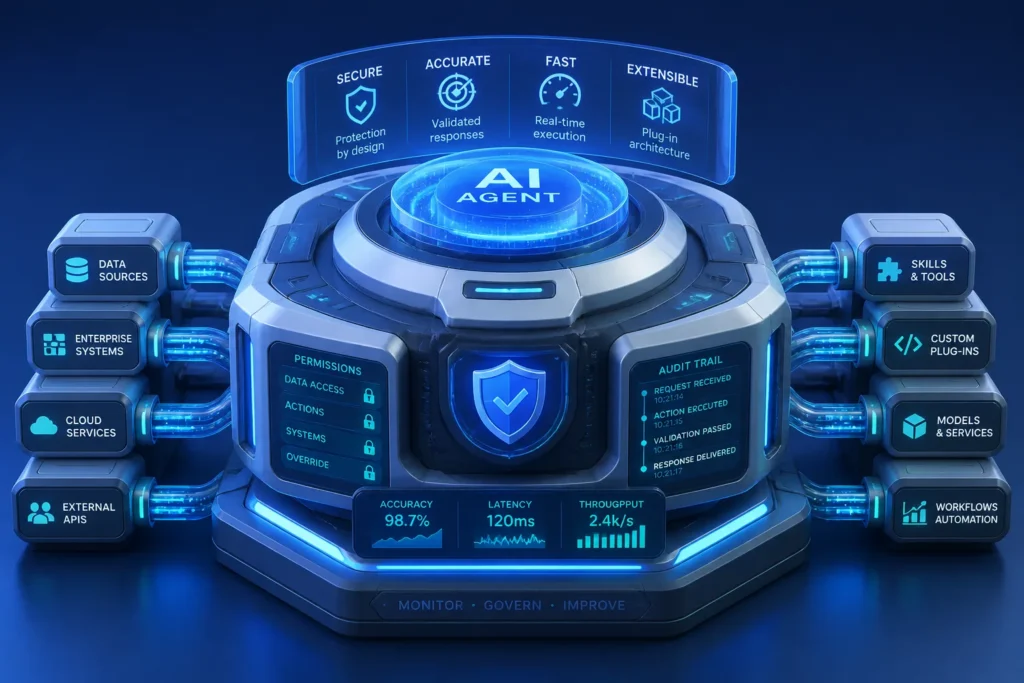
Enterprise buyers can use the SAFE framework: Secure, Accurate, Fast, and Extensible. Compare SDKs, pre-built connectors, MCP support, permissions, data access, and governance over automated actions before choosing a platform. A serious review should also cover version control, audit logs, monitoring, observability, and cost tracing. Best AI Agent Platforms Compared for should ask whether a platform supports RAG, persistent memory, low-code design, custom nodes, tool and API use, collaboration, and human approval; the ledger doesn’t establish every platform’s coverage.
Best AI Agent Platforms Compared for should match capabilities to work. Salesforce Agentforce addresses CRM-centered sales and customer operations, including lead qualification and support automation. ServiceNow AI Agents address IT support, employee requests, incidents, and routing. Complex-context reasoning may require additional integration and orchestration infrastructure. LangGraph can pause a graph for human input and resume it, while its graph model gives developers control over state, branching, and error recovery. Best AI Agent Platforms Compared for should also examine hallucination control, voice readiness, multichannel continuity, deployment model, integration depth, and total cost of ownership.
What are the main security, reliability, and vendor lock-in trade-offs of the leading AI agent platforms?
Security comparisons should cover SOC 2, ISO 27001, HIPAA, GDPR, access controls, customer VPCs, on-premises, private cloud, and air-gapped deployment. Rasa states that it supports self-hosted, on-premises, private-cloud, air-gapped, and cloud deployment without hosting customer data, systems, or applications. StackAI lists on-premises and VPC deployment, access control, SSO, and SOC 2, HIPAA, and GDPR coverage. Vellum states that it never has access to user data on any deployment path. Elementum says its Zero Persistence architecture keeps data in the customer environment without copies or vendor training.
Best AI Agent Platforms Compared for should make ecosystem dependence explicit. Microsoft offerings are deeply integrated with Microsoft’s ecosystem, while Copilot Studio is less convenient outside it. Agentforce is optimized for Salesforce and has limited functionality outside Service Cloud. Developer frameworks can improve control but shift governance and security work to you: CrewAI requires significant technical expertise, while LangChain and LangGraph don’t include governance, audit logs, versioned testing, and safe rollout patterns by default. Best AI Agent Platforms Compared for should test retries, timeouts, escalation, rollback, redundancy, uptime guarantees, and failure recovery. Production multi-agent failure rates are reported at 41% to 86.7%. Best AI Agent Platforms Compared for cannot provide a complete portability score for prompts, memory, workflows, models, or integrations.


How can a business evaluate AI agent platforms through a pilot, including which tasks and performance measures to test?
A practical pilot starts with one agent and one workflow, with measurable success criteria defined before deployment. Start with simple prompts and add multi-step systems only when simpler approaches are insufficient. Best AI Agent Platforms Compared for should use one reproducible test set containing normal cases and failures: tool errors, API timeouts, context-window overflow, permission errors, and human escalation.
Best AI Agent Platforms Compared for can be scored consistently from to 5, where means weak fit and means strong fit. Score accuracy, task completion, latency, cost, extensibility, governance, observability, and user experience. Track hallucination or false-violation rates, tool-call success, workflow completion, handoff quality, token consumption, concurrency, and recovery where the platform exposes those measures. A reported compliance deployment reduced false violations from 12% to 2.4%, while another report describes accuracy rising from 71% to 93% after context isolation.
Controlled pilot success may not hold at enterprise volume. Best AI Agent Platforms Compared for should therefore require load testing, rollout controls, monitoring, and rollback before production. Document data readiness, team skills, change management, ownership, and human-review procedures in the AI Build Desk project brief. No universal implementation timeline is established in the ledger.
Which AI agent platforms are best suited to different business sizes, technical teams, and use cases?
Accessible builders fit teams that need speed without a large engineering group. Relevance AI is described as accessible to non-technical teams, startups, and business teams with limited engineering resources. Zapier Agents use no-code authoring across more than 7,000 apps, while Gumloop offers visual agents, multi-step workflows, multiple models, and hundreds of app integrations. Lindy supports personal agents for email triage, meeting preparation, and lead research. Best AI Agent Platforms Compared for should treat these as fit-based options, not universal winners.
Best AI Agent Platforms Compared for should map developer capacity carefully. CrewAI uses Python for agents, roles, and tools, with sequential, parallel, or hierarchical execution. n8n is positioned for technical teams wanting self-hosting, and LangChain suits teams with strong Python engineering capacity. Microsoft organizations may favor Copilot Studio, Salesforce-centered teams Agentforce, and cloud-committed organizations the platform aligned with their provider. Best AI Agent Platforms Compared for should end in a practical path: define the business task, prepare data and permissions, choose a chatbot, RAG system, workflow, or agent, run a measured pilot, and plan production support using AI Build Desk’s project-brief approach.

| Platform | Stated positioning or scope | Stated ecosystem or integration details |
|---|---|---|
| Salesforce Agentforce | aims to embed agents in sales, service, and marketing workflows within the CRM… | optimized for the Salesforce ecosystem and has limited functionality outside… |
| Microsoft Copilot Studio | deeply integrated with its ecosystem, but complex autonomous workflows outside… | deep integration with Teams, Office, and Azure AD; native integration with… |
| Google Cloud Vertex AI Agent Builder | suitable for enterprises with development teams building bespoke agents and… | provides native access to Gemini models and managed search features for… |
| Platform | Stated pricing |
|---|---|
| Salesforce Agentforce | $500 per 100,000 credits, approximately $2 per conversation; requires a… |
| CrewAI | pricing is not publicly listed and requires a sales demo for a custom quote… |
| Dify | Professional plan costs $59 per workspace per month and is aimed at independent… |
| Microsoft Copilot Studio | access is included with a Microsoft Copilot license, which costs $30 per… |
| Platform | Stated positioning or use case | Integration or deployment evidence | Documented pricing or limits |
|---|---|---|---|
| Salesforce Agentforce | CRM-centered sales, service, marketing, lead qualification, and support automation | Salesforce ecosystem; limited functionality outside Service Cloud | $500 per 100,000 credits; approximately $2 per conversation; Service Cloud license $175+ per user/month |
| Microsoft Copilot Studio | Low-code enterprise agent creation | Microsoft 365, Teams, SharePoint, Dynamics 365, Microsoft Graph | Access included with Microsoft Copilot license listed at $30 per user/month when paid yearly |
| Google Vertex AI Agent Builder | Managed bespoke-agent builder for GCP-oriented enterprises | Gemini models, managed search, RAG, memory, and governance | Usage-based pricing and current usage limits are not fully stated in the ledger |
| Rasa | Developer platform with flexible deployment | Self-hosted, on-premises, private cloud, air-gapped, and cloud deployment | Free Developer Edition: one bot per company; up to 1,000 external or internal conversations monthly |
| CrewAI | Developer-oriented multi-agent framework with visual design | Python-defined agents, roles, tools, and collaborative workflows | Basic plan includes workflow executions monthly; Enterprise pricing is custom |
| Dify | Low-code/no-code agent builder | Model switching and pre-built connectors | Professional plan: $59 per workspace/month |
| n8n | Technical-team workflow and agent builder | More than integrations; JavaScript or Python; self-hosting | Starter plan: $24/month; 2,500 workflow executions; five concurrent executions |
| Zapier Agents | No-code agent authoring | Cloud-only execution across more than 7,000 apps | Current pricing and usage limits are not stated in the ledger |
| StackAI | Visual enterprise workflow builder | On-premises and VPC deployment; SOC 2, HIPAA, and GDPR listed | Current pricing and usage limits are not stated in the ledger |
| UiPath AI Agents | RPA combined with generative AI | Legacy systems and repetitive processes | Current pricing and usage limits are not stated in the ledger |
| ServiceNow AI Agents | Internal enterprise operations | IT support, employee requests, incident management, and workflow routing | Current pricing and usage limits are not stated in the ledger |
| Cognigy | Voice and contact-center agent platform | More than pre-built integrations; tens of thousands of concurrent voice calls at approximately 500ms latency | Current pricing and usage limits are not stated in the ledger |
Key Takeaways
- Choose by ecosystem, deployment model, technical capacity, governance, and use case rather than an unsupported overall ranking.
- Separate inference, orchestration, integration, support, and human-review costs when building a business case.
- Pilot one agent and one workflow before adding multi-step or multi-agent behavior.
- Test normal cases, tool failures, timeouts, permission errors, context overflow, escalation, and recovery.
- Require monitoring, rollout controls, and rollback before moving from a controlled pilot to enterprise production.
Frequently Asked Questions
Which AI agent is the best in 2026?
No single platform is established as the best for every business. Salesforce Agentforce suits Salesforce-centered CRM work, Microsoft Copilot Studio suits organizations committed to Microsoft 365, and Google’s platform suits GCP-oriented enterprises.
What is the best AI platform for agents?
The best AI platform depends on your deployment, integration, governance, and development needs. Enterprise platforms, low-code builders, and developer frameworks make different trade-offs, so the ledger does not establish one universal winner.
Are AI agents overhyped in 2026?
AI agents have practical uses, but production risks are material. One source reports production multi-agent failure rates ranging from 41% to 86.7%, with many failures attributed to specification and coordination problems.
Which is the best AI platform in 2026?
No single AI platform is best across all use cases. Your choice should reflect ecosystem fit, technical capacity, security requirements, integration depth, governance, and measurable pilot results.