How to Build a Knowledge Bot Trained on Your Own Documents usually means connecting LangChain or LlamaIndex, an embedding model, a vector database, retrieval, and an LLM through RAG. The system can ingest PDFs, Word documents, plain text, and web-page links, then retrieve relevant passages before answering. For local setups, the documented minimum is GB of RAM and GB of free SSD space.
- RAG combines information retrieval with text generation models.
- A documented chunking example uses roughly 1,000-character pages with roughly characters of overlap.
- Local tools discussed in the evidence require GB of RAM and at least GB of free SSD space.
- A RAG-generated answer can cite the source of its retrieved evidence.
- RAG can use newly indexed documentation in future queries without retraining the model.
How to Build a Knowledge Bot Trained on Your Own Documents
A knowledge chatbot retrieves relevant content from a company knowledge base before generating a customized response, while a custom-data chatbot can use help documents, FAQs, manuals, product sheets, and chat transcripts. How to Build a Knowledge Bot Trained on Your Own Documents starts with Retrieval-Augmented Generation, or RAG. RAG combines information retrieval with text generation.
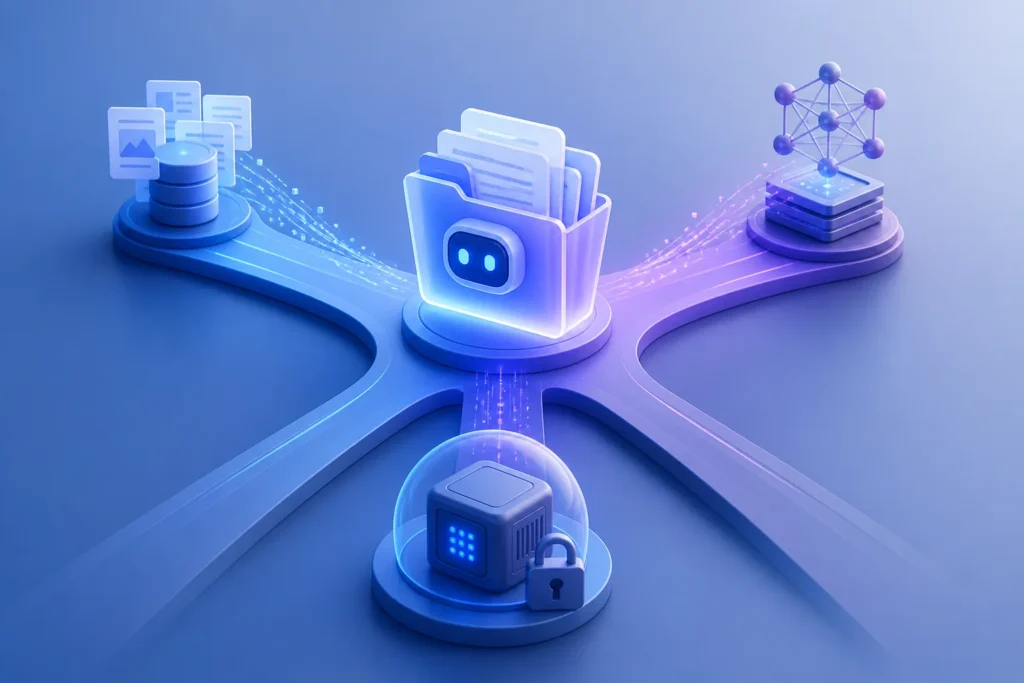
In a typical pipeline, document chunks become embeddings, embeddings are stored in a vector database, semantic search retrieves matching passages, and a large language model (LLM) generates an answer from that retrieved context. How to Build a Knowledge Bot Trained on Your Own Documents therefore means connecting an LLM to an external document repository, not necessarily training a model from scratch.
How to Build a Knowledge Bot Trained on Your Own Documents differs from fine-tuning because RAG augments the model without modifying its underlying weights, whereas fine-tuning adjusts model parameters using domain-specific data. Product names such as LangChain, AnythingLLM, Msty, GPT-4, the OpenAI Assistants API, ChatGPT Enterprise, and Azure OpenAI may appear in implementation comparisons, but the available evidence doesn’t establish comparative capabilities or pricing for every named product.


When should you use retrieval-augmented generation, fine-tuning, or a local language model for a document-based bot?
RAG is the strongest starting point when your bot needs current, organization-specific, private, or citable information, particularly when the knowledge changes. How to Build a Knowledge Bot Trained on Your Own Documents is therefore mainly a retrieval design problem when policies, manuals, or web content change regularly. How to Build a Knowledge Bot Trained on Your Own Documents should use retrieval for a GB collection rather than trying to access the entire dataset at once.
Fine-tuning suits terminology, domain nuances, tone, format, or other behavior changes. Its learned knowledge remains static until retraining, so a fine-tuned model lacks updated external knowledge unless it connects to another source. How to Build a Knowledge Bot Trained on Your Own Documents can combine both methods when you need changed behavior and external knowledge: a specialized fine-tuned model can operate inside a RAG architecture.
A local language model runs entirely on a PC without cloud or internet dependence, although small models may be less accurate.
What document formats, chunk sizes, and metadata work best when preparing files for a knowledge bot?
PDF files, Word documents, plain text, and links to web pages are documented input options for a knowledge bot. How to Build a Knowledge Bot Trained on Your Own Documents should not assume that CSV files or PowerPoint files (PPTX) are generally supported, because the available evidence doesn’t establish that support. How to Build a Knowledge Bot Trained on Your Own Documents also needs an ingestion step that loads files and automatically splits large documents.
One chunking example uses pages of roughly 1,000 characters, breaking at spaces so words aren’t split, with roughly characters of overlap. How to Build a Knowledge Bot Trained on Your Own Documents should preserve source metadata such as file path and name, then add tags or categories so retrieval can filter relevant material.
Excel spreadsheets need separate treatment: the documented approach puts Excel content in a database and provides functions to an Assistant API so it can retrieve relevant data. The evidence doesn’t establish a universal spreadsheet-ingestion method. Clean, short, organized files help processing and responses, while scanned PDFs, complex tables, CSV files, and PPTX files require an extraction workflow that the evidence doesn’t specify.

What steps are required to ingest your documents, create embeddings, and connect them to a chatbot interface?
Document ingestion, meaning-preserving chunking, embedding creation, vector storage, retrieval, and prompt construction form the main RAG pipeline. How to Build a Knowledge Bot Trained on Your Own Documents should embed each document chunk with an embedding model, store the vectors in a vector database, retrieve matching passages, and place those passages in the LLM prompt. How to Build a Knowledge Bot Trained on Your Own Documents can use LangChain or LlamaIndex because both provide components for ingestion, embeddings, retrieval, and prompt construction.
At query time, semantic search embeds the user’s question, compares the resulting vector with document vectors using cosine similarity, and selects top results. A configurable k value can set the maximum number of returned documents. How to Build a Knowledge Bot Trained on Your Own Documents can expose the result through Streamlit, website embed code, a shared link, Slack, or an API.
AnythingLLM’s documented workflow is to create a workspace, upload documents, move them into that workspace, and select “Save and Embed”. In one test, AnythingLLM embedded a roughly 150-page PDF in to minutes, while Msty often took three to four times as long. Msty is also reported to provide exact source information when citing.

What model, hardware, and API costs should you expect when building and running a knowledge bot?
RAG and fine-tuning have different cost profiles. How to Build a Knowledge Bot Trained on Your Own Documents with RAG requires database maintenance, prompt resources, and token costs for both retrieved context and generated responses. How to Build a Knowledge Bot Trained on Your Own Documents with fine-tuning requires compute-intensive training, including dataset preparation and sufficient GPU capacity.
Local tools discussed in the evidence require GB of RAM and at least GB of free SSD space. A stronger local setup recommends at least GB of RAM, an SSD, and a GPU for better performance, especially with larger models. Older PCs with GB of RAM may run simplified, quantized models with to billion parameters, while one test reported better responses from a 7-billion-parameter model.
How to Build a Knowledge Bot Trained on Your Own Documents may include storage stated at 0.2 dollars per GB per day in one example. Full fine-tuning can reach thousands or tens of thousands of dollars depending on the model and run. The available evidence doesn’t provide current API prices for GPT-4, Azure OpenAI, ChatGPT Enterprise, or the OpenAI Assistants API.

How can you make the bot cite its sources and respond safely when its documents do not contain an answer?
Source display should be part of the chatbot interface so users can trace an answer to the documents or retrieved evidence behind it. How to Build a Knowledge Bot Trained on Your Own Documents should make source review visible rather than treating the generated answer as self-verifying. How to Build a Knowledge Bot Trained on Your Own Documents can use RAG-generated citations because a RAG answer can cite the source of its retrieved evidence.
How to Build a Knowledge Bot Trained on Your Own Documents still needs citation testing: the available evidence doesn’t guarantee that every implementation will produce accurate citations automatically, and RAG accuracy depends on the information retrieved.
Configure a fallback response for questions outside the document collection instead of allowing the model to guess. An uninformed model may hallucinate and invent an answer. Prompt instructions can tell the LLM to answer from retrieved context, identify uncertainty, and expose the source document used for the response.

How can you protect sensitive documents and restrict which users can access them?
Document security should combine encryption in transit and at rest, granular access controls, and authorized access to chatbot datasets. How to Build a Knowledge Bot Trained on Your Own Documents should apply permissions before retrieval, not only after an answer has been generated. How to Build a Knowledge Bot Trained on Your Own Documents can enforce document-level permissions so retrieval returns only files the current user is allowed to see.
How to Build a Knowledge Bot Trained on Your Own Documents should keep proprietary data in a secured database controlled by the organization. RAG permits that data to be updated, removed, or access-restricted without retraining the model. A RAG architecture can also keep sensitive data in a secured environment with strict access controls.
Review both paths through which information can leak: the foundation model’s training data and the retrieval dataset. When data cannot leave the organization, the documented options include on-premise deployment, locally run models, single sign-on, and a secured REST API.
How do you test answer accuracy and update the bot when its source documents change?
Testing should use sampled real user questions and evaluate retrieval and generation separately. How to Build a Knowledge Bot Trained on Your Own Documents should measure retrieval precision and recall, factual accuracy, hallucination rate, and faithfulness. How to Build a Knowledge Bot Trained on Your Own Documents should also include human review of realistic questions and answers.
Operational measures can include response accuracy, resolution rate, user satisfaction, and escalation rate. How to Build a Knowledge Bot Trained on Your Own Documents stays current through incremental indexing, regular re-indexing, document replacement, website re-crawling, and updates to the document index. Newly indexed documentation can become available to future RAG queries without retraining the model.
Deletion and version management remain implementation requirements. The evidence supports removing documents and restricting access, but it doesn’t specify a particular version-control system. AI Build Desk can help businesses prepare a project brief, choose an implementation approach, or evaluate AI developers; the supplied evidence contains no specific service pricing or call-to-action wording.

| Approach | Update or knowledge behavior | Cost or resource notes | Reported performance |
|---|---|---|---|
| RAG | can be updated, removed, or access-restricted without retraining | additional runtime resources for database maintenance and prompts | — |
| Fine-tuning | model knowledge remains static until retraining | computationally expensive | — |
| hybrid systems | — | — | consistently outperformed fine-tuning-only or RAG-only approaches across several… |
| Approach | Data handling | Access or security mechanism |
|---|---|---|
| RAG | keeps proprietary data in a secure database under the organization’s control | can enforce access controls by requiring user permissions for retrieval of… |
| local document chatbot setup | running entirely on a PC, with no cloud requirement or internet dependence | — |
| federated fine-tuning and retrieval | can leverage cross-institutional knowledge without exposing raw patient data | — |
| on-premise deployment | For settings where data cannot leave the organization | locally run models, single sign-on, and a secured REST API |
| Approach | Knowledge behavior | Cost or resource notes | Best-supported use |
|---|---|---|---|
| RAG | Retrieves external knowledge at query time; can be updated, removed, or access-restricted without retraining | Database maintenance, prompt resources, and retrieved-context and response token costs | Useful for current, private, organization-specific, or citable information |
| Fine-tuning | Model knowledge remains static until retraining | Compute-intensive training; a full run can cost thousands or tens of thousands of dollars | Useful for terminology, tone, format, or behavior changes |
| Hybrid | Combines a fine-tuned model with a RAG architecture | Requires both fine-tuning resources and RAG runtime resources | Used when both behavior changes and external knowledge are needed |
Key Takeaways
- Use RAG when document knowledge is current, private, organization-specific, or needs citations.
- Chunk documents while preserving source metadata, then filter retrieval with tags or categories.
- Keep retrieval permissions at the document level so users receive only authorized material.
- Test retrieval and generation separately, including precision, recall, factual accuracy, hallucination rate, and faithfulness.
- Update the index when documents change so future queries can use new content without retraining.
Frequently Asked Questions
Can I create my own AI chatbot?
Yes. You can create a custom-data chatbot by connecting a chatbot interface to a document repository, retrieval system, and language model. A local document chatbot requires a local AI model, a document database, and a chatbot interface.
What to not ask an AI?
You shouldn’t ask an AI to invent information when its documents contain no answer. Configure a fallback response instead, because an uninformed model may hallucinate and make up an answer.
How do I create my own knowledge base?
Create your knowledge base by ingesting documents, splitting them into meaning-preserving chunks, generating embeddings, and storing the vectors in a vector database for semantic search. Add source metadata and categories so retrieval can filter relevant material.
How to create a chatbot using Scratch?
The supplied evidence doesn’t explain how to create a document knowledge bot using Scratch. The documented approaches instead use document ingestion, embeddings, vector databases, retrieval, and a language model.